
The Directorate General of Shipping has advised Indian maritime agencies to restrict the deployment of seafarers to conflict areas following a US military strike that killed three Indian crew members off the Oman coast. India has also protested the attack, which occurred amidst heightened tensions in the Gulf region.

The American warship stopped the tanker "after it attempted to sail to an Iranian port," according to a statement released by CENTCOM.

Amid ongoing tensions with the US, Iran's IRGC Navy has issued new directives restricting maritime movement through the Strait of Hormuz, allowing only civilian vessels on Iranian-designated routes and barring all military ships.

The United States Central Command (CENTCOM) has confirmed the implementation of a naval blockade on Iranian ports, enforcing strict measures on vessels entering or departing, significantly escalating tensions between the two nations.

External Affairs Minister S Jaishankar has emphasised India's commitment to safe maritime transit and condemned attacks on merchant shipping amidst the ongoing West Asia conflict and global energy market disruptions.

The United States Central Command (CENTCOM) has announced that American forces are maintaining a strict maritime restrictive operation in the region, continuing to enforce a blockade against Iranian ports.

As many as 35 vessels, including cargo carriers and oil tankers, successfully navigated through the strategic maritime chokepoint of the Strait of Hormuz over the last 24 hours, according to Iran's state media reports citing a formal declaration by the Islamic Revolutionary Guard Corps (IRGC) Navy.

Prime Minister Narendra Modi on Sunday used two major public engagements in Kolkata to outline a broader vision for India's future -- one rooted in inner balance and collective well-being through yoga, and the other in national self-reliance and maritime strength.

US President Donald Trump claimed on Tuesday that Tehran has consented to long-term, comprehensive monitoring of its nuclear infrastructure. Concurrently, Washington will ease shipping constraints in the Strait of Hormuz and release bound financial concessions, subject to stringent American oversight.

In a major shift in Middle Eastern energy and security dynamics, the US Department of the Treasury on Monday issued a temporary 60-day general licence authorising transactions related to the production, delivery, and sale of Iranian crude oil, petrochemicals, and petroleum products.

Tensions escalate between Iran and the US over control of the Strait of Hormuz, a crucial shipping lane for global oil supplies, as both sides discuss extending a fragile ceasefire.

Israel's Defence Minister Israel Katz declared that the Israeli military will not withdraw from its security zones in Lebanon, Syria, and Gaza, directly opposing the newly announced American-led diplomatic framework with Tehran. National Security Minister Itamar Ben-Gvir further asserted Israel's sovereignty, stating, "Trump's agreement does not bind us. Israel is not subject to the United States, and we are an independent and sovereign nation!"

The United States and Iran have reached an agreement in principle to immediately and permanently halt all military operations, lift sanctions, and work towards a comprehensive final agreement within 60 days, including a significant reconstruction package for Iran.

The Quad grouping has expanded cooperation in critical minerals and energy, while unveiling new measures to boost maritime surveillance and port infrastructure across the Indo-Pacific. This move comes against the backdrop of China's growing military posturing in the region, with ministers reiterating strong opposition to destabilising actions and expressing serious concerns over militarisation of disputed features.

United States President Donald Trump and Iranian President Masoud Pezeshkian have virtually signed a 14-point memorandum of understanding (MoU) to end hostilities, reopen the Strait of Hormuz, and begin a 60-day negotiation process on sanctions and Iran's nuclear programme.

An Iranian tanker successfully bypassed the US Navy to deliver crude oil to the Asia-Pacific region, despite ongoing tensions and a US blockade.

The family of Suresh, a 44-year-old marine engineer from Visakhapatnam, is grieving after he was among three Indian crew members killed in a US military strike on a commercial vessel off the Oman coast, shattering their dreams of a family reunion for their 15th wedding anniversary.

The United States has redirected 48 vessels in the Persian Gulf, particularly in the Strait of Hormuz, over the past 20 days amid ongoing enforcement actions related to restrictions on Iranian maritime assets by the US Navy.

US President Donald Trump has dismissed media reports suggesting that diplomatic negotiations between Washington and Tehran have stalled, maintaining that dialogue persists despite intensifying geopolitical friction across the Middle East.

For the foreseeable future, the most likely outcome remains continuation of the status quo. Taiwan will remain self-governing without formally declaring independence, while China continues to apply sustained pressure short of war, predict Krishnan Srinivasan and Manoj Mohanka.

In a sharp escalation of regional tensions, US President Donald Trump issued a fresh warning to Tehran on Monday, asserting that the American military is prepared to sink any Iranian vessels that approach the newly established naval blockade in the Strait of Hormuz.
Iran has reimposed restrictions on the Strait of Hormuz, with its forces opening fire on a passing tanker and forcing at least two Indian vessels to reverse course, escalating tensions in the region and raising concerns over energy supplies.

Conflicting reports emerge regarding the effectiveness of the US blockade on Iranian ports, with Iran claiming successful transit of vessels and the US asserting complete maritime dominance.

Tensions escalate between Iran and the US following an attack on an Iranian commercial vessel in the Sea of Oman, with both sides trading accusations over maritime security and ceasefire violations.
The US blockade on Iranian ports is aimed to curb Iranian energy exports, thereby crippling its economy to force Iran back to the negotiating table, points out Commodore Venugopal Menon (retd).

Iran has strongly criticised US plans to impose a blockade on its ports, warning that maritime security across the Persian Gulf region would be jeopardised if its own security is threatened.

Donald Trump has escalated rhetoric against Iran by posting AI-generated images and videos depicting US military strikes, warning Tehran that time is running out to secure a ceasefire agreement.
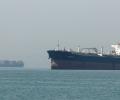
A high-stakes memorandum for a 60-day ceasefire between the United States and Iran is in its final stages, with negotiators working to close remaining gaps and avert further escalation in the region, including reopening of the Strait of Hormuz and the resumption of Iranian oil sales, according to an Axios report citing US officials.

French President Emmanuel Macron on Monday announced that France and the United Kingdom will jointly lead a multinational initiative to restore free and secure navigation in the Strait of Hormuz amid uncertainty over the virtual control of the strategic waterway between the US and Iran.

The container ship SELEN, en route to Karachi, was denied passage by the Islamic Revolutionary Guard Corps (IRGC) Navy due to lack of permission and failure to coordinate with Iranian maritime authorities.

Iran has presented a multi-layered proposal to the US in an attempt to break the deadlock in peace talks, focusing on de-escalation and nuclear programme discussions.

US President Donald Trump said the United States faces a stark choice in its approach to Iran, either to pursue a negotiated settlement or escalate militarily, as tensions continue to rise in the West Asia region.

Ali Mousavi stated that such cooperation is essential for maintaining stability in the strategic waterway.
Iran has announced the Strait of Hormuz is open to commercial vessels, coinciding with a ceasefire between Lebanon and Israel.

Despite Iran allowing 'non-hostile vessels' through the Strait of Hormuz, marine insurance premiums are expected to remain elevated due to persistent high-risk classifications and ongoing geopolitical tensions, with experts cautioning that the threat of attacks and collateral damage still exists.

The US Central Command (CENTCOM) announced the start of operations to clear mines in the Strait of Hormuz, a claim swiftly denied by Iran, leading to increased tensions in the region amidst stalled negotiations between the two countries.

Equipped with advanced weaponry, the HMS Anson is fitted with "Tomahawk Block IV land-attack missiles" with a range of 1,600 km and "Spearfish heavyweight torpedoes," providing formidable offensive capabilities.

Pakistan's Punjab government has announced the reopening of all public and private educational institutions after implementing fuel-saving measures due to the conflict in West Asia. The decision comes as fuel supply stabilises and the government secures national fuel stocks.

US President Donald Trump has indefinitely extended the ceasefire with Iran at the request of Pakistan, aiming to allow Tehran's leadership time to form a unified proposal to end the seven-week war.

The chairman of maritime company Safesea Group has described the attack on the US-owned crude oil tanker Safesea Vishnu, which resulted in the death of an Indian crew member, as "deliberate and calculated". He emphasised the need for governments to ensure the safety of commercial shipping lanes and seafarers.
